
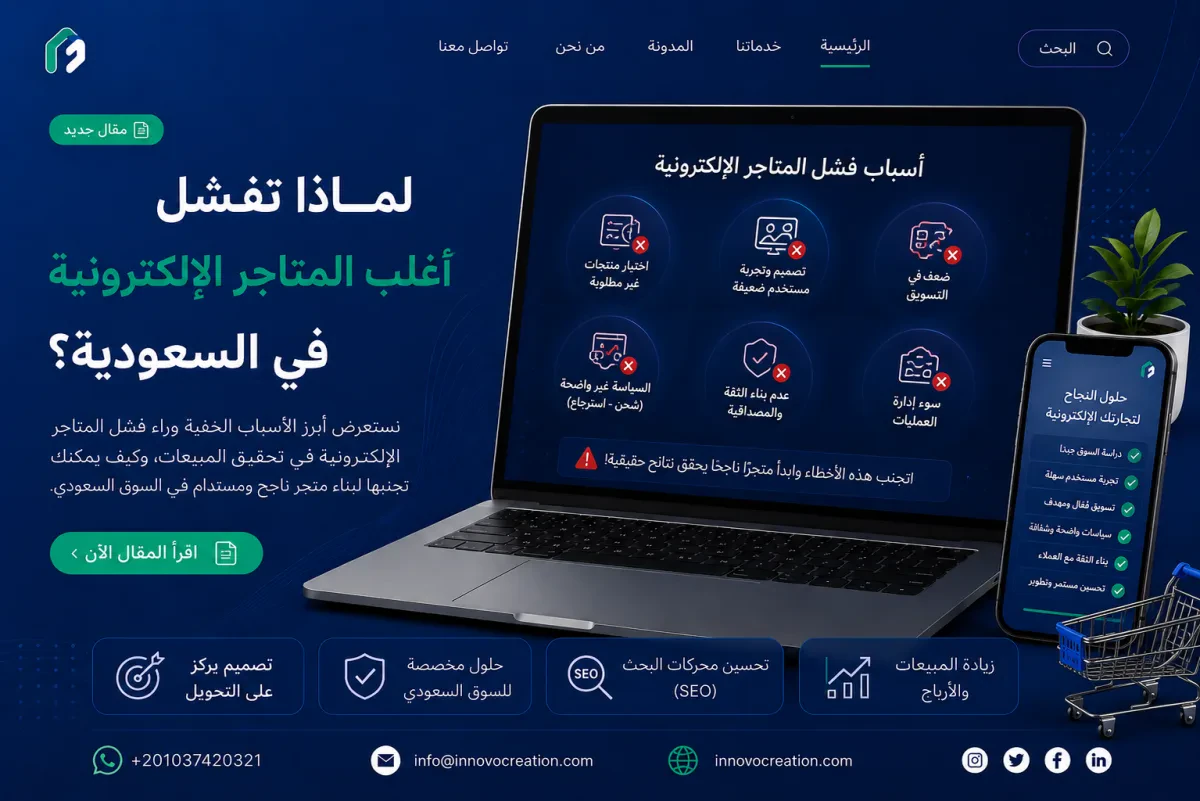
In the Saudi e-commerce market, it is very common to see online stores investing heavily in daily advertising campaigns across Google and social media platforms.
However, despite consistent traffic and sometimes very high visitor numbers, many of these stores fail to achieve expected sales results.
This creates a confusing situation for business owners: if traffic is coming in, why aren’t sales increasing?
In most cases, the issue is not marketing—it is technical.
The Real Issue Is Not Traffic, It’s the System
An e-commerce store is not just a product showcase. It is a full technical system that depends on:
- System performance under load
- Database efficiency
- Backend architecture
- API response time
- User flow logic
Even a small weakness in one of these layers can directly affect revenue.
Performance Breakdowns Under Advertising Pressure
When advertising campaigns start scaling, traffic increases suddenly.
If the system is not properly engineered:
- Pages start loading slowly
- Server response time increases
- Checkout becomes unstable
- Users drop before completing purchases
At that moment, the store loses customers not because of the product, but because of system limitations.
Modern development treats performance as a core architecture decision, not an optional improvement.
User Experience Is Not Just Design
A common misunderstanding in the market is that user experience is visual design.
In reality, UX is about:
- The number of steps to complete a purchase
- The clarity of the buying journey
- Reduction of friction points
- Speed of decision-making
Every unnecessary step in the purchase flow reduces conversion rates significantly.
The Problem with Non-Custom Systems
Many stores rely on predefined structures that are not built specifically for their business model.
The issue with these systems is:
- Limited scalability
- Generic architecture
- Unnecessary code overhead
- Weak optimization for performance
- Restrictions in customization
Custom development, on the other hand, allows full control over:
- System design
- Performance optimization
- User journey structure
- Business-specific logic
This is where real differences in results start to appear.
Backend Issues That Are Often Ignored
While most attention goes to the frontend, the real problems often exist in the backend:
- Unoptimized database queries
- Lack of caching strategies
- Poor API structure
- Inefficient order processing logic
These issues are invisible to users but directly impact conversion rates and revenue.
An E-commerce Store Is a Sales Engine, Not a Website
Successful e-commerce platforms are not built as product catalogs.
They are built as:
- Conversion systems
- Behavior tracking engines
- Sales funnels
- Data-driven optimization platforms
Without this mindset, the store remains a visual layer without real business impact.
Why Custom Development Changes Everything
Custom-built systems allow full control over performance, scalability, and user experience.
They enable:
- High-speed performance even under heavy traffic
- Fully optimized checkout flows
- Business-specific logic implementation
- Integration with marketing systems
- Continuous optimization based on real data
This is why companies like Innovo Creation approach e-commerce not as websites, but as complete sales systems designed to handle real business growth and conversion challenges.