
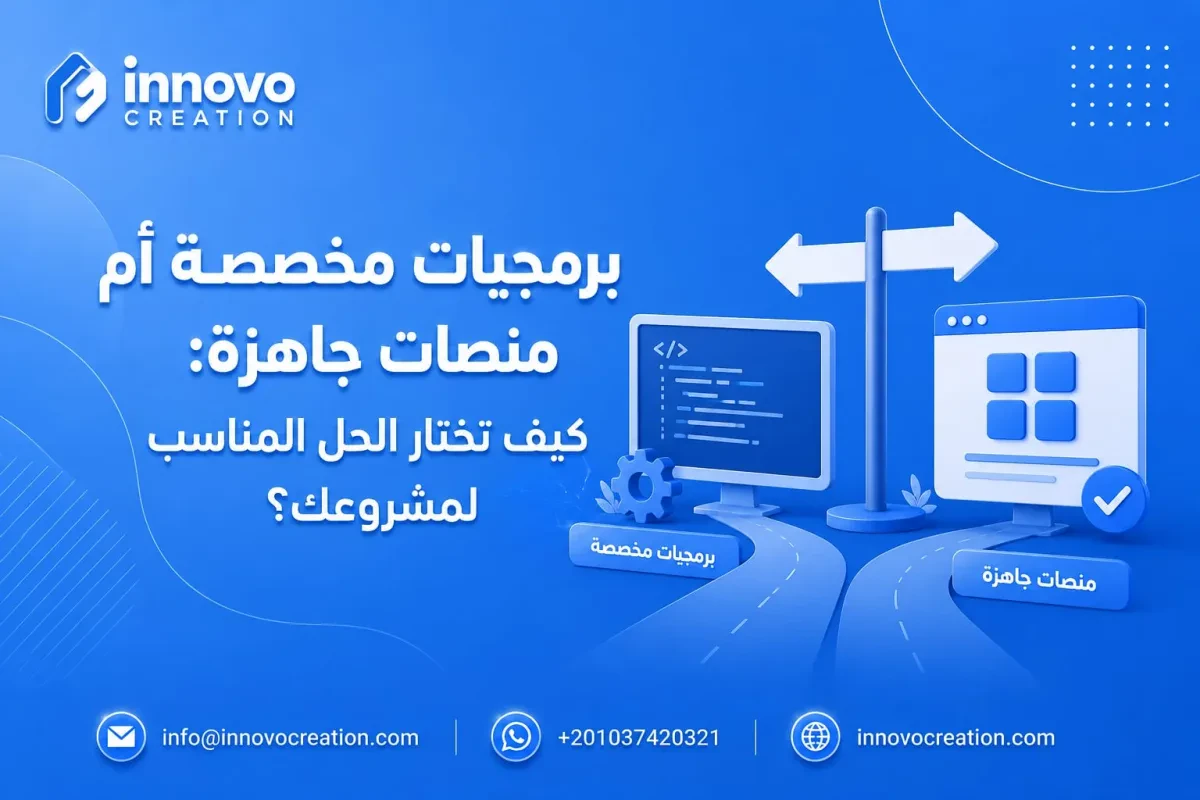
When starting a new tech project, one of the most important strategic decisions is not design or development—it is choosing the foundation of your system. Should you rely on a ready-made platform, or build a fully custom solution from scratch?
This decision is not purely technical. It directly affects cost, scalability, flexibility, and long-term growth.
What Are Ready-Made Platforms (SaaS)?
Ready-made platforms are pre-built systems designed to provide general functionality that can be used immediately without building anything from scratch.
Examples include e-commerce platforms, CRM systems, accounting tools, and booking systems.
The main idea behind these solutions is simple: start quickly, operate immediately, but within predefined limits.
When Ready-Made Platforms Make Sense
Ready-made platforms are a strong choice when the project is simple or still in the validation stage.
They are especially useful when you want to test an idea in the market quickly without heavy investment or technical complexity.
In this case, speed is more important than flexibility.
However, limitations usually appear once the project starts growing.
What Is Custom Software?
Custom software is a system built specifically for a single project from the ground up.
Every feature, workflow, and structure is designed based on the business itself rather than a generic template.
This approach provides full control and maximum flexibility, but it requires more time and higher initial investment.
Practical Comparison Between Both Approaches
Instead of looking at theory, it is better to understand the difference from a real-world perspective.
Ready-made platforms help you launch quickly, while custom software gives you long-term control and scalability.
In simple terms, ready-made platforms are like renting a fully equipped office, while custom software is like building your own headquarters from scratch.
Direct Comparison
| Factor | Ready-Made Platforms | Custom Software |
|---|---|---|
| Launch speed | Very fast | Slower initial development |
| Initial cost | Low | Higher |
| Flexibility | Limited | Highly flexible |
| Scalability | Restricted | Fully scalable |
| Control | Limited | Full control |
| Customization | Basic | Unlimited |
When You Actually Need Custom Software
Custom systems become necessary when your project starts moving beyond standard use cases.
For example, when you have complex workflows, advanced permission structures, or a user experience that must be unique in the market.
It is also essential when your competitive advantage depends on technology itself rather than just the idea.
The Hybrid Model (The Most Practical Approach)
In many real-world projects, the best solution is not choosing one side, but combining both.
A custom-built core system handles the main business logic, while ready-made tools are used for secondary services.
Example:
Custom-built core system
Combined with ready-made services such as:
Payment gateways
Email services
Analytics tools
This approach creates a balance between speed, flexibility, and cost efficiency.
Behavioral Comparison From a Business Perspective
| Scenario | Ready-Made Platforms | Custom Software |
|---|---|---|
| Fast MVP launch | Ideal | Not necessary |
| Long-term scalable product | Limited | Highly suitable |
| Very low budget | Best option | Can be expensive |
| Differentiated product | Not suitable | Best choice |
How to Make the Right Decision
The decision should never be based on cost alone. It should be based on the nature and future of the project.
Ask yourself:
Does the project require fast launch or long-term scalability?
Will the requirements change over time?
Do I need deep customization?
Do I have a technical team to manage the system?
The answers to these questions define the correct direction.
Common Mistakes
Many projects fail not because of the idea, but because of the wrong technical choice at the beginning.
Common mistakes include:
Using a ready-made platform for a highly scalable product
Building a custom system too early without validating the idea
Ignoring future scaling costs
Not considering long-term maintenance
These mistakes usually do not appear immediately, but become critical during growth.
Conclusion
Ready-made platforms are ideal for fast launches and reducing initial costs, but they become limiting as the project grows.
Custom software is the best choice for projects that require scalability, flexibility, and long-term control.
In many cases, the hybrid model is the most practical and intelligent solution because it combines speed with full control.
Innovo Creation
We help you choose the right technical approach for your project, whether it is using ready-made platforms for a fast start or building a fully custom system for long-term scalability and growth. Our decisions are based on your real business goals, not just initial cost, ensuring a sustainable and scalable solution.